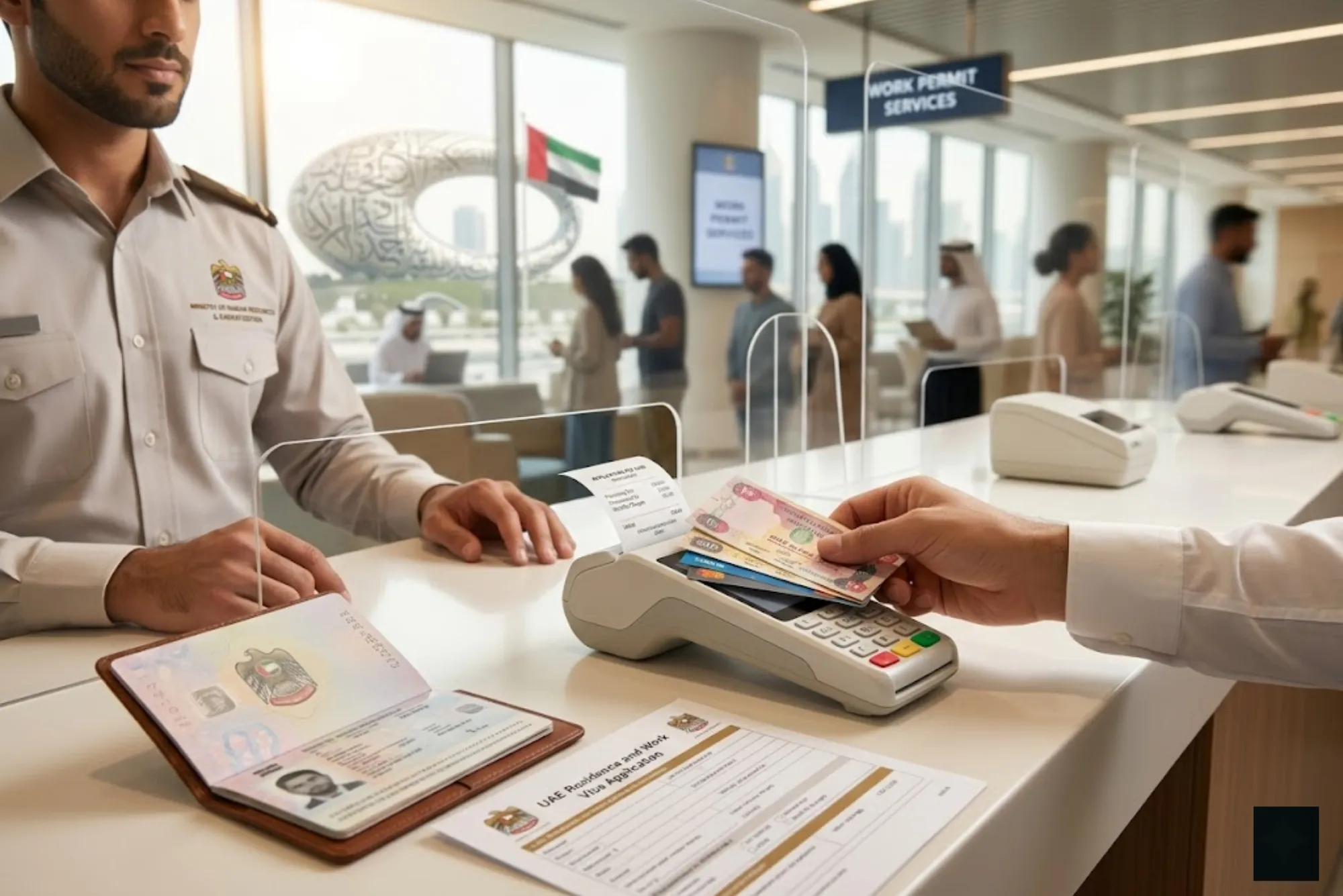
For mainland private-sector employees, the official fee structure shows that the work permit itself depends on the employer’s category, while residency charges are added separately. In practice, the total can look very different from one case to another depending on whether the employee is applying from outside the UAE, switching status from inside the country, or working through a company classified under a higher labour category. A clear breakdown helps applicants and employers budget properly and avoid confusion.
Quick Answer: UAE Work Visa Price in 2026
The core official work permit fee in the UAE starts with AED 50 as the work permit application charge. After that, the two-year work permit issuance fee depends on the employer’s category: AED 250 for Category 1, AED 1,200 for Category 2, and AED 3,450 for Category 3. Beyond the permit, residency issuance adds more government fees, and other costs such as medical fitness, Emirates ID, tax, and collection charges may also apply.
| Core Fee Item | Official Amount |
|---|---|
| Work permit application fee | AED 50 |
| Two-year work permit issuance – Category 1 | AED 250 |
| Two-year work permit issuance – Category 2 | AED 1,200 |
| Two-year work permit issuance – Category 3 | AED 3,450 |
| Business center commission cap | AED 72 per service |
This means the official government-linked cost of a UAE work visa can begin relatively low on paper but rise quickly depending on employer classification and later residence steps. Anyone comparing broader immigration costs can also look at the wider UAE visa price list in 2026 for more general visa context.
What Does “UAE Work Visa” Actually Include?
In everyday conversation, people often use “work visa” as one combined term, but the process actually has multiple parts. For a normal employment route, the employer first secures the work permit, and then the employee’s residence permit is completed after entry and post-arrival steps. The work permit is linked to the job approval side, while the residence permit is what allows the employee to live legally in the UAE for the approved period.
For private-sector mainland employment, the standard employment visa is generally valid for two years and renewable, while some free zone arrangements can differ. That distinction matters because many online articles mix mainland and free zone rules together, which makes pricing look inconsistent even when the official systems are following separate structures.
Main Official Work Permit Fees in 2026
The official Ministry of Human Resources and Emiratisation service for recruiting a worker from overseas gives one of the clearest fee breakdowns for normal employment permits. The work permit application itself is AED 50 across Categories 1, 2, and 3. The larger difference comes from the permit issuance fee for two years, which changes sharply based on company classification.
That classification-based model is important because it explains why one employer may quote a much lower work visa cost than another. The underlying work permit is not priced equally for all companies. When applicants hear very different fee figures from different employers, the reason is often the company’s labour category rather than a random price difference.
| Employer Category | Permit Duration | Permit Issuance Fee |
|---|---|---|
| Category 1 | 2 years | AED 250 |
| Category 2 | 2 years | AED 1,200 |
| Category 3 | 2 years | AED 3,450 |
On top of that, business center commission is capped at AED 72 per service when a service center is used. The same official service notes that the published fees do not include tax and collection charges, so the number you see in a transaction summary can still be slightly higher than the core published fee.
Residence Permit Charges After the Work Permit
Once the work permit stage is in place, the employee’s residence permit has to be completed. The official residence issuance service shows a AED 100 application fee, a AED 100 residence issuance fee per year, and a AED 100 smart services fee. For a typical two-year employment residence, that means the residence side alone usually starts from AED 400 in core government fees before you add medical fitness, Emirates ID-related costs, and any local service handling.
| Residence Fee Item | Official Amount |
|---|---|
| Residence permit application fee | AED 100 |
| Residence issuance fee per year | AED 100 |
| Smart services fee | AED 100 |
| Typical 2-year residence issuance total | AED 400 |
| Status adjustment fee (if applying inside UAE) | AED 500 |
That status adjustment charge is especially important for applicants already inside the UAE. When the person is not exiting and re-entering but instead completing the process from within the country, this extra AED 500 can become part of the work visa budget. For online application comparisons, the article on UAE visa online pricing can also support broader cost planning.
Total Expected Cost: What Is Confirmed and What Varies?
The easiest way to understand UAE work visa pricing is to separate confirmed official fees from variable charges. Confirmed core fees include the AED 50 work permit application charge, the category-based two-year work permit issuance fee, the capped service-center commission where relevant, and the residence issuance charges. Variable items include medical fitness testing, Emirates ID-related expenses, tax and collection charges, and any extra handling depending on the case.
| Scenario | Confirmed Core Government Fees | What Still Varies |
|---|---|---|
| Category 1, outside UAE | AED 700 (AED 50 + AED 250 + AED 400) | Medical, Emirates ID, tax, collection, optional service-center charges |
| Category 2, outside UAE | AED 1,650 (AED 50 + AED 1,200 + AED 400) | Medical, Emirates ID, tax, collection, optional service-center charges |
| Category 3, outside UAE | AED 3,900 (AED 50 + AED 3,450 + AED 400) | Medical, Emirates ID, tax, collection, optional service-center charges |
| Applying from inside UAE | Add AED 500 status adjustment to the relevant total | Medical, Emirates ID, tax, collection, optional service-center charges |
These totals are useful because they are built only from confirmed official fee components. They do not invent medical, ID, or tax figures where an exact universal amount is not consistently published in the same fee structure. That makes the estimate practical while still staying accurate.
Who Pays the UAE Work Visa Cost?
In a standard compliant private-sector hiring process, the employer is expected to bear the costs of recruitment, travel related to recruitment, and the expenses of obtaining the worker’s residency permit in the UAE. That point is important because many workers incorrectly assume they must legally shoulder the official work visa cost themselves. In reality, a legitimate employer-arranged hiring process is meant to carry these official onboarding and residency expenses on the employer side.
For job seekers, that means a demand for large unofficial “visa money” can be a warning sign rather than a routine requirement. Anyone dealing with UAE employment paperwork should separate official charges from unofficial demands and should avoid assuming every private payment request is part of the lawful visa process.
Required Documents and Conditions
The official work permit service sets out several important requirements. The employee must be at least 18 years old, the employer must have a valid electronic quota, and the establishment must maintain a valid licence without violations that suspend its activity. The application must also be submitted by the employer’s authorized signatory.
Document requirements include a clear photo with white background, a passport valid for at least six months, the official job offer signed by both employer and employee, and academic certificates for relevant skill levels. For licensed professions such as healthcare or teaching roles, the relevant professional licence is also required.
- Passport valid for at least 6 months
- Clear personal photograph
- Signed official job offer
- Academic certificate where required by skill level
- Professional licence for regulated professions
- Extra ID copy for some nationalities where required
Applicants comparing work and other visa routes may also benefit from reading the broader Travels Village homepage for related travel and immigration topics.
UAE Work Visa Process in 2026
The process becomes much easier when broken into stages. First comes employer-side work permit approval, then entry and post-arrival formalities, and finally the residence permit completion. The government systems are designed around sequence, so skipping or confusing one step usually creates delays rather than saving time.
- The employer submits the new work permit application through the official channel.
- The Ministry reviews compliance, documents, and job offer details.
- After approval, the required permit fees and any guarantee or insurance-related amounts are paid.
- The employee enters the UAE or changes status from inside the UAE where applicable.
- Medical fitness and Emirates ID-related procedures are completed.
- The residence permit is issued and linked to the employment arrangement.
For work-bundle cases under the labour system, the residence procedure must generally be completed within 60 days of entry. Delays beyond that window can cause unnecessary fines and administrative trouble, which is why applicants and employers should keep the process moving after arrival rather than treating the entry stage as the end of the procedure.
Extra Charges, Risks, and Common Budget Mistakes
One of the biggest mistakes people make is quoting only the work permit fee and ignoring the rest of the process. Medical fitness, Emirates ID, status adjustment, tax, and collection charges can all move the final amount upward. Another mistake is assuming all UAE work visa cases cost the same regardless of employer category. The difference between Category 1 and Category 3 work permit issuance is large enough to change the total budget completely.
There is also the risk of overstay. Official ICP rules state that a fine of AED 50 applies for each day of overstay after the entry permit has expired or been cancelled, starting after the applicable grace period. That makes timing an important cost factor in addition to the visa fee itself.
- Ignoring employer category differences
- Forgetting residence issuance charges
- Not budgeting for status change inside UAE
- Assuming medical and ID steps are included in one flat fee
- Delaying completion and risking overstay fines
Frequently Asked Questions
How much is a UAE work permit in 2026?
The official work permit application fee is AED 50. The two-year issuance fee then depends on the employer category: AED 250 for Category 1, AED 1,200 for Category 2, and AED 3,450 for Category 3.
How much is the UAE residence permit after the work permit?
The core residence issuance fees typically include AED 100 application fee, AED 100 per year for residence issuance, and AED 100 smart services fee. For a two-year residence, that gives a base total of AED 400 before medical and related steps.
What is the status adjustment fee inside the UAE?
When the process is completed from inside the UAE, the official status adjustment fee is AED 500.
Who pays for the UAE work visa?
In a compliant private-sector employment process, the employer is expected to bear the recruitment, travel-related recruitment, and residency permit expenses connected to hiring the employee.
How long is a standard UAE mainland employment visa valid?
A normal mainland employment visa is generally valid for two years and renewable, while some free zone arrangements can differ.
Conclusion
UAE work visa price in 2026 is not one flat number. The official cost begins with the work permit application and the employer-category issuance fee, then rises through residence permit charges and any extra items such as status adjustment, medical fitness, Emirates ID, tax, and collection fees. That is why the most realistic way to budget is to separate confirmed government fees from variable post-approval charges.
For a basic mainland private-sector case, the confirmed government-linked total can start from AED 700 in a Category 1 outside-UAE scenario, but it climbs much higher in Category 2 or Category 3 cases and rises again when status adjustment and other steps are added. Anyone planning carefully should review the work permit stage, the residence stage, and the supporting charges together rather than relying on a single headline fee.
Related Reading: 2 Days Dubai Visa Price in 2026: Latest Fees, Cost & Charges
Related Reading: 3 Month Visit Visa UAE Price in 2026: Latest Fees, Cost & Charges
Related Reading: Latvia Work Visa Fees Price in 2026: Latest Fees, Cost & Charges — full guide
Related Reading: Study Visa Australia Price in 2026: Latest Fees, Cost & Charges — full guide