Introduction
Flying with a dog or cat can be much easier when your pet can stay with you in the cabin. However, choosing among the best airline approved pet carriers requires more than finding a bag with an “airline approved” label. Airlines have their own rules for carrier dimensions, pet size, ventilation, seating locations, and under-seat storage.
The Federal Aviation Administration (FAA) allows individual airlines to determine whether pets can travel in the passenger cabin. When permitted, the pet carrier is treated as carry-on baggage and must remain properly stowed under the seat during aircraft movement, takeoff, and landing.
That makes under-seat fit one of the most important factors when choosing a carrier. A comfortable carrier that is too tall or wide for your aircraft may not be accepted at the airport.
This guide explains what to look for in the best airline approved pet carriers, how to check under-seat dimensions, and how to balance airline compliance with your pet’s comfort.
What Makes the Best Airline Approved Pet Carriers?
The phrase “airline approved” can be confusing. There is no single universal carrier certification that guarantees acceptance on every airline. Instead, each airline establishes its own requirements.
A carrier that works perfectly for one airline may not work for another. Even the same airline can have different under-seat space depending on the aircraft.


For example, American Airlines currently recommends soft-sided carriers measuring up to 18 × 11 × 11 inches for its flights. It also states that the carrier must fit beneath the seat without excessive collapsing.
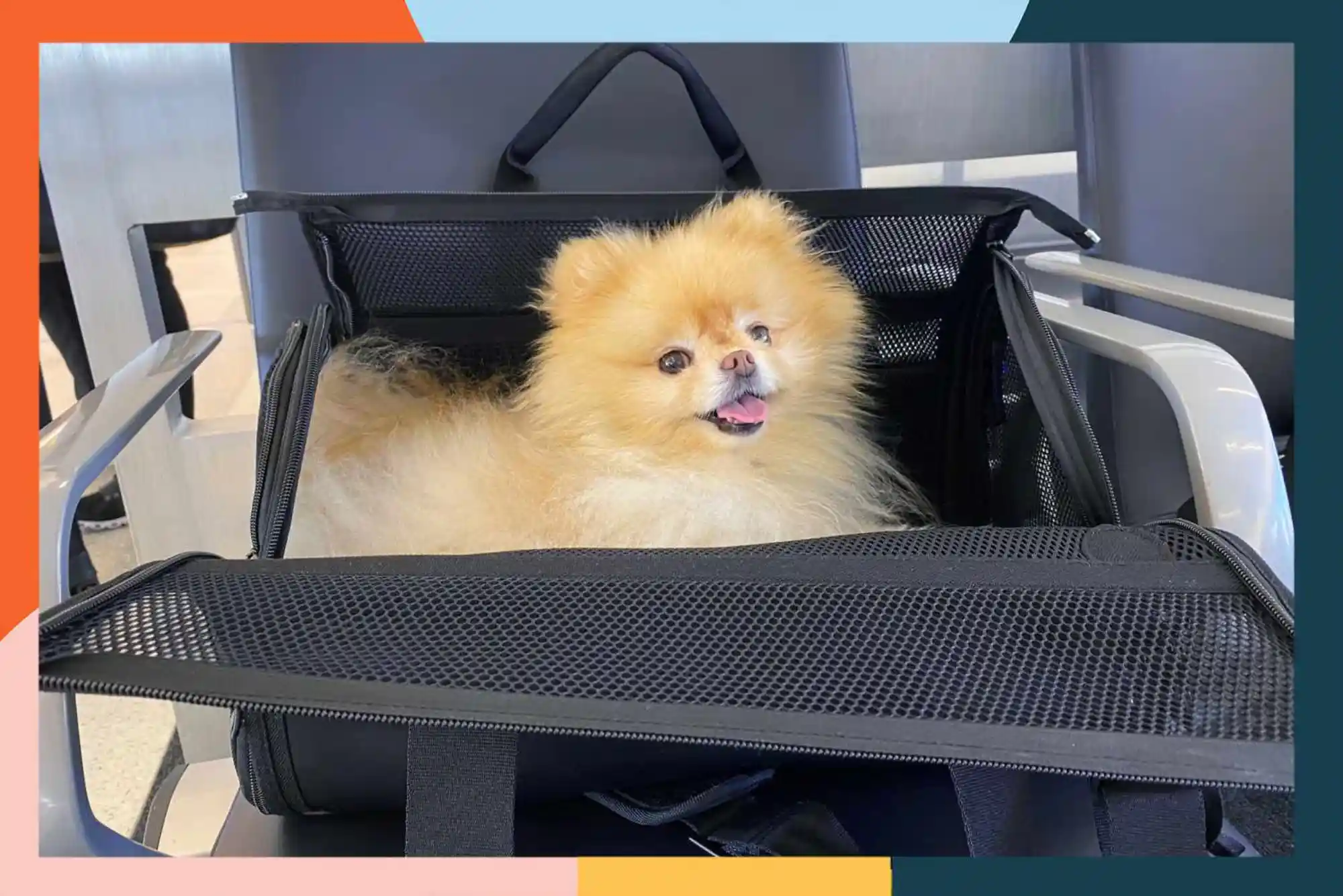
This is why the best airline approved pet carriers are usually soft-sided models with some structural support. They provide enough flexibility to fit into restricted under-seat areas while still protecting the pet.
A suitable carrier should also have strong ventilation, secure closures, a leak-resistant interior, and enough room for your pet to sit, turn around, and lie down comfortably.
Why Under-Seat Fit Matters So Much
When traveling with a pet in the cabin, the carrier normally has to go underneath the seat in front of you. That space is surprisingly limited.
The FAA requires an accepted pet container to fit beneath the passenger seat without blocking anyone’s path to the main aisle. It must also remain properly stowed during aircraft movement and takeoff and landing.
This creates an important shopping rule: measure the airline’s available space before buying the carrier.
Do not assume that a carrier advertised as “airline approved” will fit your specific aircraft. Airline policies and aircraft configurations can vary.
Height is especially important. A carrier might have an acceptable length and width but still be too tall to slide underneath the seat.
A soft-sided design can help because the upper portion may flex slightly when placed under the seat. However, flexibility does not mean you should force an oversized carrier into a space that is too small.
Soft-Sided vs. Hard-Sided Pet Carriers
For most in-cabin flights, soft-sided carriers are the more practical choice.
Soft carriers generally have flexible walls, which makes them easier to position under an airplane seat. They are also lighter and often include exterior pockets for documents, treats, collapsible bowls, and other travel essentials.
American Airlines specifically recommends soft-sided carriers for carry-on pets and notes that they should be secure, padded, water-repellent, and ventilated on at least three sides.
Hard-sided carriers provide greater structural rigidity. That can be useful for certain pets, but the fixed shape can make under-seat fitting more difficult.
A hard carrier that technically matches the listed dimensions may still be awkward if the aircraft has an unusually shaped under-seat area.
For that reason, travelers should consider the aircraft as carefully as the carrier itself.
How to Measure Your Pet for an Airline Carrier
Choosing the right carrier starts with your pet, not the product dimensions.
Measure your pet while standing naturally. You need to understand the animal’s length, height, and overall body size before deciding whether a particular carrier will provide sufficient interior space.
Your pet should not be squeezed into a carrier simply because its weight falls below an advertised maximum.
A small dog can have a long body, while a compact cat may need additional headroom. Breed, body shape, age, and temperament can therefore affect carrier selection.
The goal is to find a carrier that fits beneath the seat while allowing your pet to remain in a natural position.
This creates a balancing act. The carrier must be compact enough for the aircraft but spacious enough for your pet.
Ventilation Is a Major Safety Feature
Good ventilation should never be treated as an optional feature.
Look for mesh ventilation panels on multiple sides of the carrier. Cross-ventilation allows fresh air to enter while reducing the feeling of confinement.
Ventilation also makes it easier for you to monitor your pet during the journey.
Avoid carriers that rely heavily on a single small mesh opening. A pet traveling for several hours needs adequate airflow, particularly when the carrier is positioned beneath a seat.
The carrier should also have secure mesh that your pet cannot easily tear or push through.
A strong zipper system is equally important. Curious cats and determined small dogs can be surprisingly talented escape artists.
Padding and Interior Comfort
Airplane floors and airport terminals are not exactly famous for being cozy.
A carrier with a removable padded base can make a noticeable difference. Look for padding that provides cushioning without taking up so much internal space that your pet becomes cramped.
A waterproof or water-resistant liner is another practical feature.
Travel can cause nervous accidents, particularly when pets are unfamiliar with airports. A removable liner makes cleaning much easier.
The interior should also avoid sharp edges, exposed hardware, loose threads, or components that could become dangerous if your pet scratches or chews them.
Security Features to Look For
The best airline approved pet carriers should provide multiple layers of security.
A reliable zipper is essential, but a zipper-locking feature can provide additional protection. Some carriers also include an internal tether that can attach to a harness.
If a carrier has an internal tether, it should be used carefully and according to the manufacturer’s instructions. It should never restrict normal movement or create a strangulation risk.
The carrier should have a stable base and strong handles. Airport transfers involve lifting, setting down, and carrying the bag repeatedly.
A carrier that becomes unstable when lifted can be stressful for both you and your pet.
Check Your Airline Before Buying
One of the biggest mistakes travelers make is purchasing a carrier first and checking airline rules afterward.
The correct order is the opposite.
First, check the airline’s current pet policy. Then check the maximum carrier dimensions for your specific route and aircraft. Finally, choose a carrier that fits those requirements while providing appropriate space for your pet.
Airlines can also restrict where passengers traveling with pets may sit.
American Airlines, for example, does not allow carry-on pets in certain bulkhead and exit-row seats, and some aircraft have additional restrictions because of under-seat storage.
Alaska Airlines similarly states that pets traveling in the cabin must fit in an under-seat carrier, with space subject to availability.
These examples demonstrate why an online product description should never be treated as a guarantee of airline acceptance.
How Much Flexibility Should a Carrier Have?
Some flexibility is helpful, but excessive flexibility can create problems.
A carrier should have enough structure to maintain its shape around your pet. If the walls collapse too easily, your pet may have less usable interior space once the bag is underneath the seat.
At the same time, a completely rigid carrier may not work well in a confined under-seat area.
A reinforced soft-sided carrier usually offers a useful middle ground. The base remains stable while the upper structure can accommodate minor variations in under-seat clearance.
However, never depend on compressing a carrier beyond the airline’s requirements.
Airline Approved Does Not Mean Universal Approval
This is worth repeating because it is one of the biggest misconceptions surrounding pet travel.
A manufacturer may describe a carrier as “airline approved,” but that does not mean every airline will accept it.
The FAA itself explains that airlines establish their own cabin pet policies and additional requirements.
Consequently, the term should be treated as a starting point rather than a guarantee.
The safest approach is to compare the carrier’s actual dimensions with the airline’s published requirements.
Also check your aircraft type if that information is available before departure.
Preparing Your Pet for the Flight
Even the best airline approved pet carriers will not automatically make a nervous pet comfortable.
Introduce the carrier several days or weeks before the trip whenever possible.
Leave it open at home and allow your pet to investigate it voluntarily. Add familiar bedding or an item carrying a familiar scent.
Short practice sessions can also help. Allow your pet to spend progressively longer periods inside the carrier before the actual journey.
This is particularly useful for cats and dogs that associate carriers exclusively with stressful experiences such as veterinary appointments.
Avoid waiting until the morning of the flight to introduce the carrier.
What to Pack for Your Pet’s Cabin Journey
Space inside an airplane is limited, so keep your pet’s travel supplies practical.
Bring essential documentation, identification information, a small amount of food, waste bags, cleaning supplies, and a collapsible water bowl.
You should also carry any documents required for your destination.
Pet travel requirements can change depending on the airline, destination, and type of animal. International travel may involve additional veterinary and government requirements.
The FAA recommends contacting the airline directly because airline-specific rules can apply to cabin pet travel.
Common Mistakes When Choosing a Pet Carrier
One common mistake is focusing only on weight.
A carrier can be lightweight and still be completely unsuitable if it is too tall or lacks adequate ventilation.
Another mistake is buying the largest possible carrier. Bigger is not automatically better when your pet must fit underneath an aircraft seat.
Some travelers also forget to check the aircraft rather than just the airline.
Aircraft designs differ, and under-seat storage can vary between configurations. American Airlines explicitly notes that non-collapsible kennels cannot exceed the under-seat dimensions of the aircraft being used.
Finally, do not assume that a carrier that worked on a previous flight will automatically work on your next one.
Different routes can involve different aircraft.
How to Choose the Right Carrier for Your Trip
Start by recording your airline’s maximum permitted carrier dimensions.
Next, measure your pet carefully and compare the interior dimensions rather than relying solely on the carrier’s exterior size.
Then consider ventilation, padding, waterproofing, zipper security, structural support, and ease of carrying through the airport.
For most travelers, a soft-sided carrier with a reinforced base, multiple mesh panels, secure closures, and a washable interior is a practical design.
If you frequently fly with your pet, it can also be worthwhile to choose a carrier that works across several airlines. Even then, verify the dimensions before every trip.
Airline policies can change, and aircraft assignments can change too.
Choosing the Best Airline Approved Pet Carrier
Finding the best airline approved pet carriers for in-cabin flights is ultimately about matching three things: your pet, your airline, and your aircraft.
A soft-sided carrier with strong ventilation, secure closures, comfortable padding, and a stable base is often a practical choice for under-seat travel. However, no carrier should be considered universally approved simply because a manufacturer uses that phrase.
Always verify the airline’s current requirements before traveling. Confirm the carrier dimensions, check your aircraft when possible, review seating restrictions, and make sure your pet can remain comfortable inside the carrier.
Most importantly, introduce the carrier before your trip so your pet has time to become familiar with it.
FAQs
What size pet carrier is allowed on an airplane?
There is no universal airline carrier size. Each airline establishes its own limits, and the available under-seat space can vary by aircraft.
For example, American Airlines currently lists 18 × 11 × 11 inches for soft-sided carry-on pet carriers. Travelers should verify the current dimensions directly with their airline before departure.
What is the best pet carrier for flying in the cabin?
The best carrier is one that meets your airline’s current dimensions while giving your pet adequate ventilation, security, and usable interior space.
For many travelers, a soft-sided carrier is practical because it can provide some flexibility in a restricted under-seat area.
Can I take my pet carrier on the plane under the seat?
Yes, when the airline permits pets in the cabin, the carrier generally needs to be stored underneath the seat in front of you.
The FAA requires an accepted pet container to remain properly stowed during aircraft movement, takeoff, and landing.
Are soft or hard pet carriers better for flying?
Soft-sided carriers are often more practical for in-cabin flights because they can accommodate tight under-seat spaces. Hard-sided carriers offer greater rigidity but may be harder to fit underneath certain seats.
The airline’s specific rules should determine which design is suitable.
How do I know if my pet carrier will fit under an airplane seat?
Check your airline’s published maximum dimensions and compare them with the carrier’s exterior measurements.
Do not rely solely on the phrase “airline approved.” The airline and aircraft ultimately determine whether the carrier can be accommodated.
Can I take a large dog in a cabin pet carrier?
Usually, only small pets that can comfortably remain inside an approved carrier can travel as ordinary cabin pets. Airlines establish their own size, species, destination, and carrier requirements.
Service-animal rules are separate and should not be confused with ordinary pet travel.
Can a pet carrier be too big for an airplane?
Yes. A carrier that is too large may not fit beneath the seat and may therefore be rejected for cabin travel.
The carrier needs to comply with the airline’s maximum dimensions and under-seat requirements.
Should my pet be able to stand inside an airline carrier?
Your pet should have enough room to maintain a reasonably natural and comfortable position. Carrier standards also emphasize adequate space and ventilation.
Do not choose a carrier solely by weight rating. Your pet’s body dimensions and the carrier’s usable interior space matter just as much.