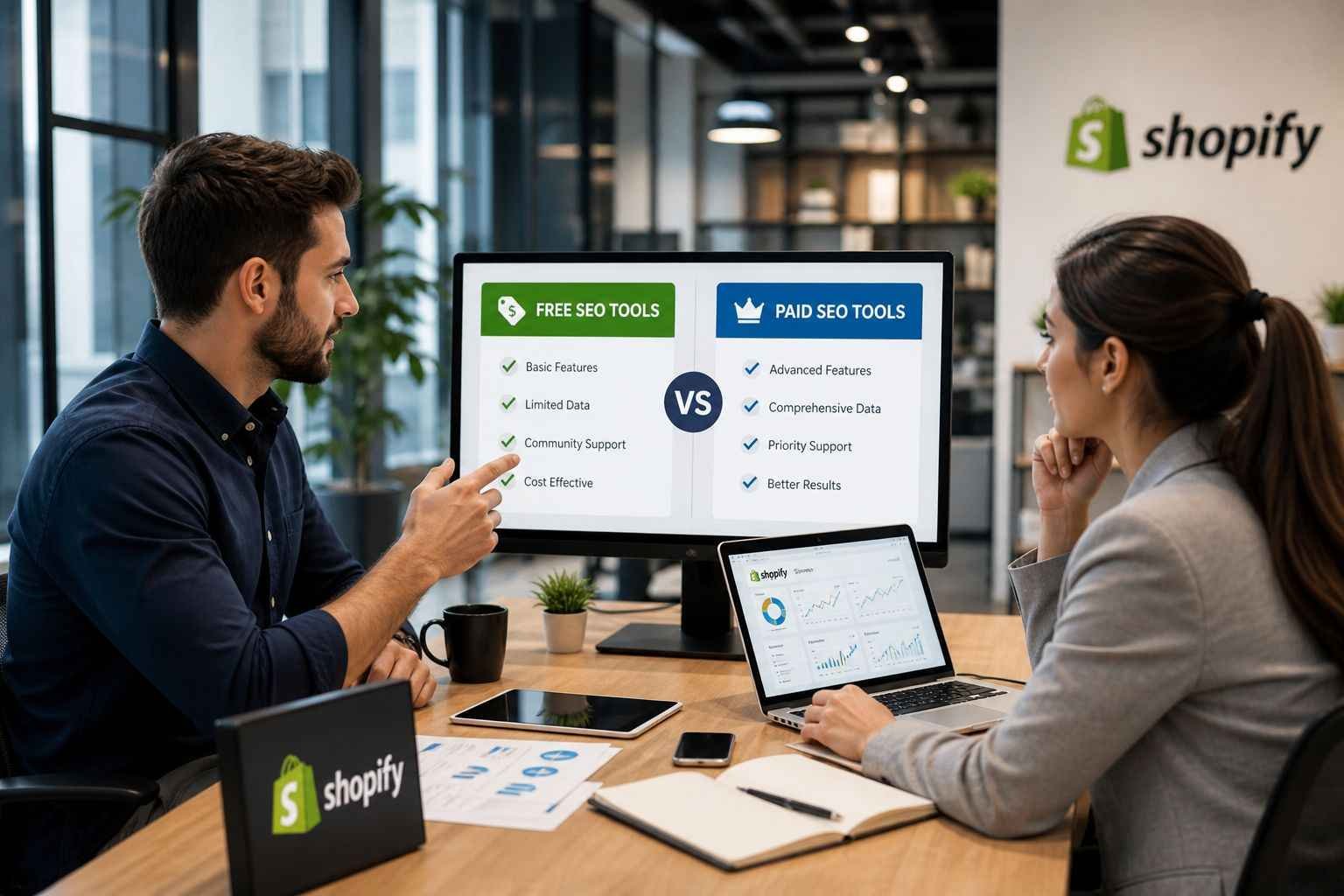
While free tools promise accessibility and simplicity, paid SEO platforms offer advanced insights that can directly influence revenue. The real question is not which is cheaper, but which drives sustainable growth for your Shopify business.
Understanding the SEO Landscape for Shopify in 2026
SEO in 2026 is driven by machine learning signals, user behavior tracking, and real-time content performance evaluation. Shopify store owners are no longer competing only on product quality—they are competing on visibility intelligence.
Modern SEO tools now go beyond keyword tracking. They analyze page experience, bounce patterns, content engagement, and even product intent mapping. This is why selecting the right SEO toolkit is a strategic business decision rather than a technical one.
What Free SEO Tools Offer Shopify Stores
Free SEO tools are often the first step for new Shopify entrepreneurs. They provide basic functionality that helps understand website performance without any financial investment.
However, their capabilities are limited when compared to advanced platforms. They are useful for early-stage optimization but often lack depth in competitive analysis and predictive SEO insights.


Core Benefits of Free SEO Tools
- Basic keyword research and suggestions
- Simple site audits for technical errors
- Limited backlink tracking
- Google Search Console integration insights
These tools are helpful for identifying surface-level SEO issues, especially for new Shopify stores still building traffic foundations.
Limitations of Free SEO Tools in Real Ecommerce Growth
As Shopify stores scale, free tools start showing limitations. They often fail to provide deep competitor intelligence or detailed conversion tracking, which are essential in competitive niches.
Many store owners eventually realize that free tools only show “what is wrong,” but rarely explain “how to fix it at scale.”
Why Paid SEO Tools Are Becoming Essential in 2026
Paid SEO tools are designed for performance-driven ecommerce environments. They combine AI-powered insights, predictive analytics, and competitor benchmarking into a single dashboard.
These platforms help Shopify owners not just track rankings but actively improve them using actionable data.
Key Advantages of Paid SEO Tools
- Advanced keyword clustering and intent mapping
- Competitor backlink intelligence
- Real-time ranking updates
- Content optimization scoring systems
- AI-based SEO recommendations
For Shopify businesses aiming to scale internationally, these features become critical for outperforming competitors.
Free vs Paid SEO Tools: A Practical Comparison
| Feature | Free Tools | Paid Tools |
|---|---|---|
| Keyword Research | Basic suggestions only | Advanced clustering + intent analysis |
| Competitor Analysis | Very limited | Deep competitive insights |
| Technical SEO Audit | Basic errors detection | Full site health scoring |
| Ranking Tracking | Limited updates | Real-time tracking |
This comparison clearly shows that while free tools are useful for beginners, paid tools dominate in scalability and precision.
Where Shopify Store Owners Make the Wrong Decision
A common mistake among Shopify entrepreneurs is relying too heavily on free tools for too long. While this may reduce short-term costs, it often slows down long-term growth.
SEO is not a one-time setup—it is a continuous optimization process. Without advanced tools, scaling becomes significantly harder.
For example, many successful ecommerce strategies also depend on external behavioral insights similar to pricing strategies used in ecommerce optimization systems like
smart price tracking methods.
Choosing the Right SEO Tool Based on Business Stage
Not every Shopify store needs a paid SEO tool immediately. The decision depends heavily on business maturity and traffic goals.
Stage-Based Tool Selection Strategy
- Startup Stage: Free tools for basic setup and indexing
- Growth Stage: Hybrid approach (free + limited paid tools)
- Scaling Stage: Fully paid SEO suite for competition dominance
This structured approach ensures that store owners invest in tools only when ROI justification becomes clear.
How Paid SEO Tools Improve Content Performance
One of the biggest advantages of paid SEO platforms is content optimization intelligence. They help Shopify owners understand exactly how their product descriptions, blogs, and category pages perform in real search environments.
Some tools even simulate search engine behavior to predict ranking changes before content is published.
In competitive ecommerce niches, this predictive advantage can be the difference between ranking on page one or getting lost in search results.
Impact on Ecommerce Branding and Visibility
SEO tools are not just technical utilities—they directly influence brand visibility. Strong SEO performance improves trust, organic traffic, and long-term customer acquisition.
This is especially important for Shopify stores competing in lifestyle and fashion niches where branding plays a major role, similar to insights found in
global fashion market trends.
Technology Integration in Modern SEO Tools
Modern SEO platforms are deeply integrated with AI systems, automation workflows, and analytics dashboards. They can now connect directly with Shopify dashboards, reducing manual optimization work significantly.
For technical readers interested in broader digital systems, similar automation principles are discussed in
technology-focused insights that highlight how data-driven systems are reshaping digital industries.
Final Verdict: Free vs Paid SEO Tools
Free SEO tools are valuable for beginners, but they are not built for scaling competitive Shopify stores. Paid SEO tools offer deeper insights, automation, and predictive analytics that directly impact revenue growth.
For serious Shopify entrepreneurs in 2026, investing in paid SEO tools is not an expense—it is a growth strategy.
Frequently Asked Questions
Are free SEO tools enough for Shopify beginners?
Yes, free tools are useful for initial setup and basic optimization, but they lack advanced features needed for scaling.
Do paid SEO tools guarantee higher rankings?
No tool guarantees rankings, but paid tools significantly improve optimization quality and decision-making.
What is the biggest advantage of paid SEO tools?
The biggest advantage is advanced competitor analysis and AI-driven SEO recommendations.
When should a Shopify store switch to paid SEO tools?
When traffic and revenue growth become a priority and competition increases in your niche.
Can Shopify succeed without SEO tools?
It is possible but extremely difficult. SEO tools help streamline optimization and improve long-term performance.
Related Reading: Duty Free Islands and Zones to Know
Related Reading: Affordable SEO Tools for Shopify Store Owners on a Practical Budget in 2026
Related Reading: How Shopify Store Owners Can Use SEO Tools to improve technical SEO without getting overwhelmed in 2026 — full guide
Related Reading: Best All-in-One SEO Tools for Shopify Store Owners in 2026: What to Use and Why — full guide